
What Happens in Every Class
Concept Instruction
Every class opens with a new idea, introduced through discussion and hands-on demonstration. Students do not copy notes, they reason through concepts together and apply them to their experiences.
Applied Problem Solving
Students tackle real problems using the concept from that day, practising multiple approaches before settling on a strategy. There is always more than one way to arrive at a correct answer.
Logic and Strategy Challenges
Every class includes a logic or spatial puzzle designed to stretch reasoning independently of computation. These build the flexible thinking that standardized curricula rarely address.
Homework Review and Discussion
Homework questions are discussed. Students explain their reasoning, compare answers with their peers and instructors give targeted feedback in a continuous growth loop.
Curriculum Spotlight
Classifying & Sorting Objects
In Lesson 18, students are given a simple task: sort a basket of mixed objects. At first, they group by familiar attributes like colour or shape. Then the task opens up. They are challenged to sort the same objects again, but in a completely different way: by texture, material, purpose, or something entirely their own. Suddenly, there is no single correct answer. A smooth stone and a metal spoon might belong together. Or not. What matters is not the grouping itself, but the reasoning behind it.
The activity becomes a conversation. Students must explain their thinking, defend their choices, and make sense of someone else’s logic. Every scientist, analyst, and problem-solver who has ever organized complex information has done exactly this.
Critical thinking begins here, with a basket of objects and the question: Why does this belong here?

What Topics Do we Cover in this Level?
Number & Data
- Counting and comparing numbers to 20
- Introduction to addition and subtraction
- Exploring place value (numbers 11 to 19)
- Canadian coins and money amounts
- Reading and creating bar graphs
- Describing groups as even or odd
and more
Geometry & Measurement
- Identifying and classifying 2D shapes
- Introduction to 3D shapes and nets
- Comparing objects by length
- Combining shapes to make new shapes
- Comparing shapes by number of sides
- Designing structures using 2D and 3D shapes
and more
Patterns, Logic & Time
- Recognizing and extending patterns
- Classifying and sorting by attributes
- Ordering events by time (days, months)
- Reading analog clocks to the nearest hour
- Addition and subtraction with number lines
- Problem solving using ten-frames
and more
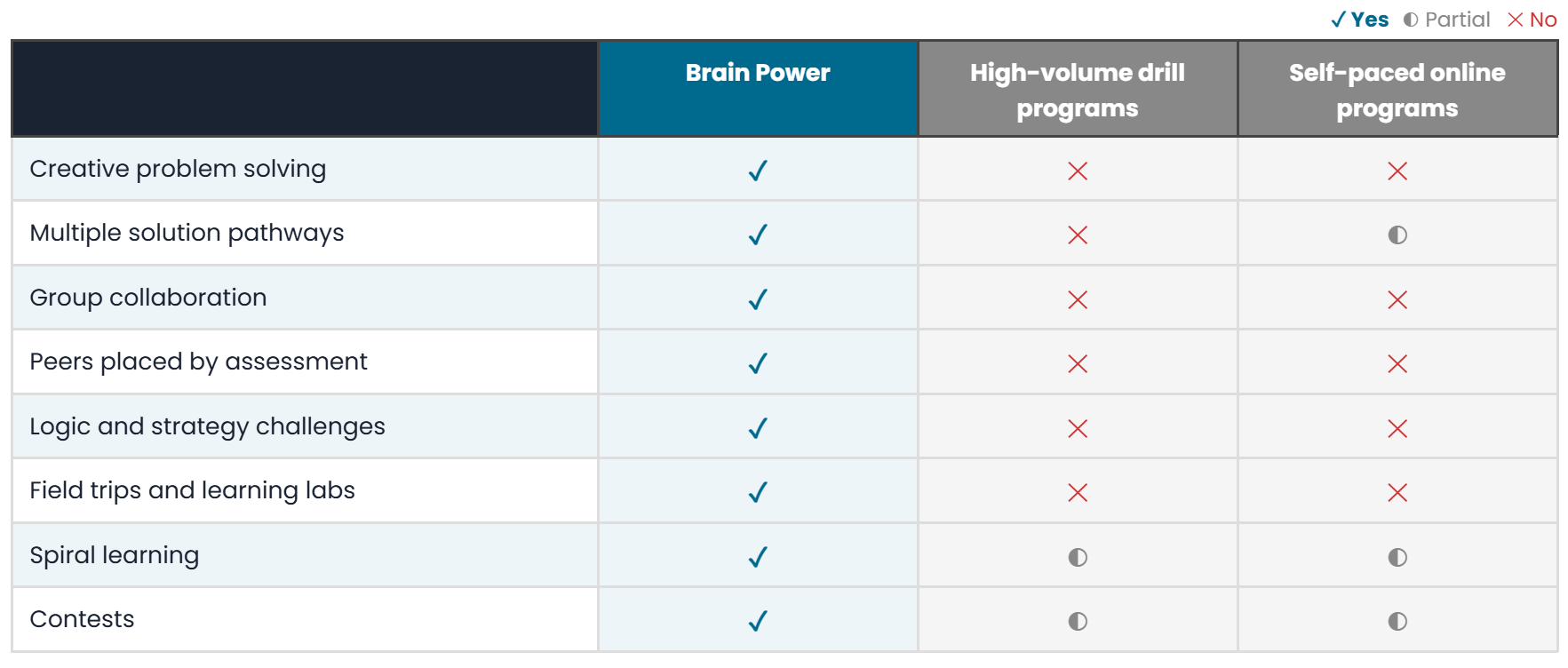
How Does Brain Power Compare?
Explore Locations
Find this program at these campuses
This program is currently offered and find a location that works for you.
British International School of Houston
Houston
Kingsway, Humber Valley
Etobicoke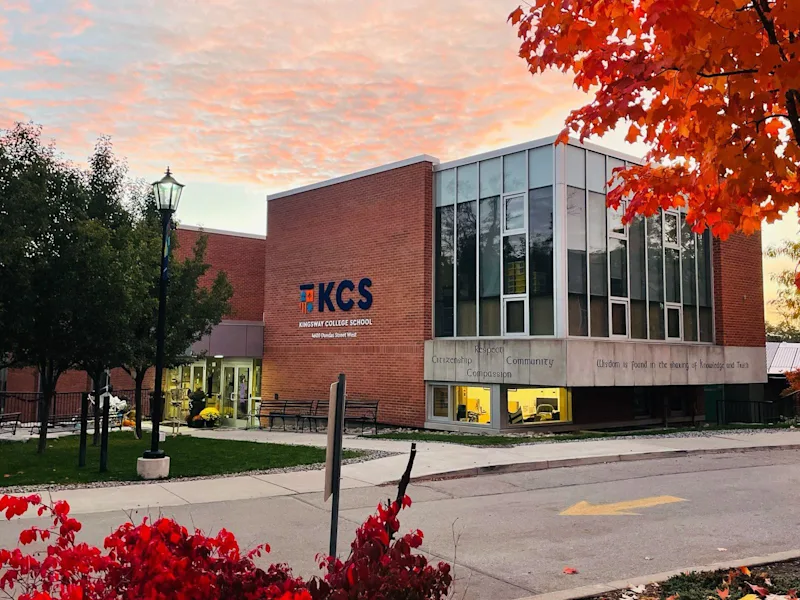
British International School of Chicago Lincoln Park
Chicago
Thornhill Woods
Vaughan
Oak Ridges/Jefferson
Richmond Hill
Olde Oakville
Oakville
Bathurst Manor
North Toronto
Port Credit
Mississauga
Downtown Markham
Markham
Kingsway, High Park
Etobicoke
Annex
Downtown Toronto