
Math & Problem Solving
Math Level B
Ratios, the coordinate plane, and proportional thinking at full speed.
What Happens in Every Class
Concept Instruction
Each class introduces a new concept through discussion and worked examples. Students build proportional reasoning, coordinate geometry, and algebraic thinking before working through problems independently.
Applied Problem Solving
Students apply new concepts to multi-step real-world scenarios. Rate problems, scale drawings, and percent relationships require students to set up the problem correctly before solving, not just execute a familiar procedure.
Logic and Strategy Challenges
Every class includes a standalone logic challenge. Constraint-based puzzles, deduction grids, and number theory problems build the reasoning flexibility that carries students well past this level.
Homework Review and Discussion
Homework is reviewed as a class. Students compare solution paths, instructors identify underlying misconceptions, and targeted feedback is given to each student before the next concept layers on top.
Curriculum Spotlight
The Harbor Rhythm Problem
In Lesson 9, students are told three ships leave the same harbour on a fixed schedule: Ship A every 2 hours, Ship B every 5 hours, Ship C every 6 hours. They all departed together this morning. When will all three be in port at the same time again?
Students deconstruct the problem to determine when the ships will overlap. They work with the lowest common multiple of all three ship’s times to determine the first hour which all three ships will return, to get a final answer of 30. They can take it a step further, by finding out how many times the ships will return to the harbor together in one week.
Synchronisation problems of exactly this type appear in computer processor scheduling, traffic light timing, and manufacturing line coordination. Any system where multiple independent cycles need to align uses the same underlying mathematics.
Number theory, introduced through a harbour. That is what memorable mathematics looks like.

What Topics Do we Cover in this Level?
Number and Operations
- Integers, absolute value, and the number line
- Fractions, decimals, and percentages
- Order of operations with rational numbers
- Lowest common multiple and prime factorization
- Percent proportions and percent relationships
- Part, whole, and percent calculations
and more
Ratios, Rates, and Algebra
- Ratios and proportional relationships
- Rate problems and unit rates
- Scale factor and scale drawings
- Variables and one-variable equations
- Equations with perimeter and area
- Proportional reasoning across contexts
and more
Geometry and the Coordinate Plane
- The coordinate plane and all four quadrants
- Plotting and interpreting ordered pairs
- Area and volume of composite figures
- Angles and 2D shape properties
- Perimeter and area using equations
- Interpreting and constructing scale drawings
and more
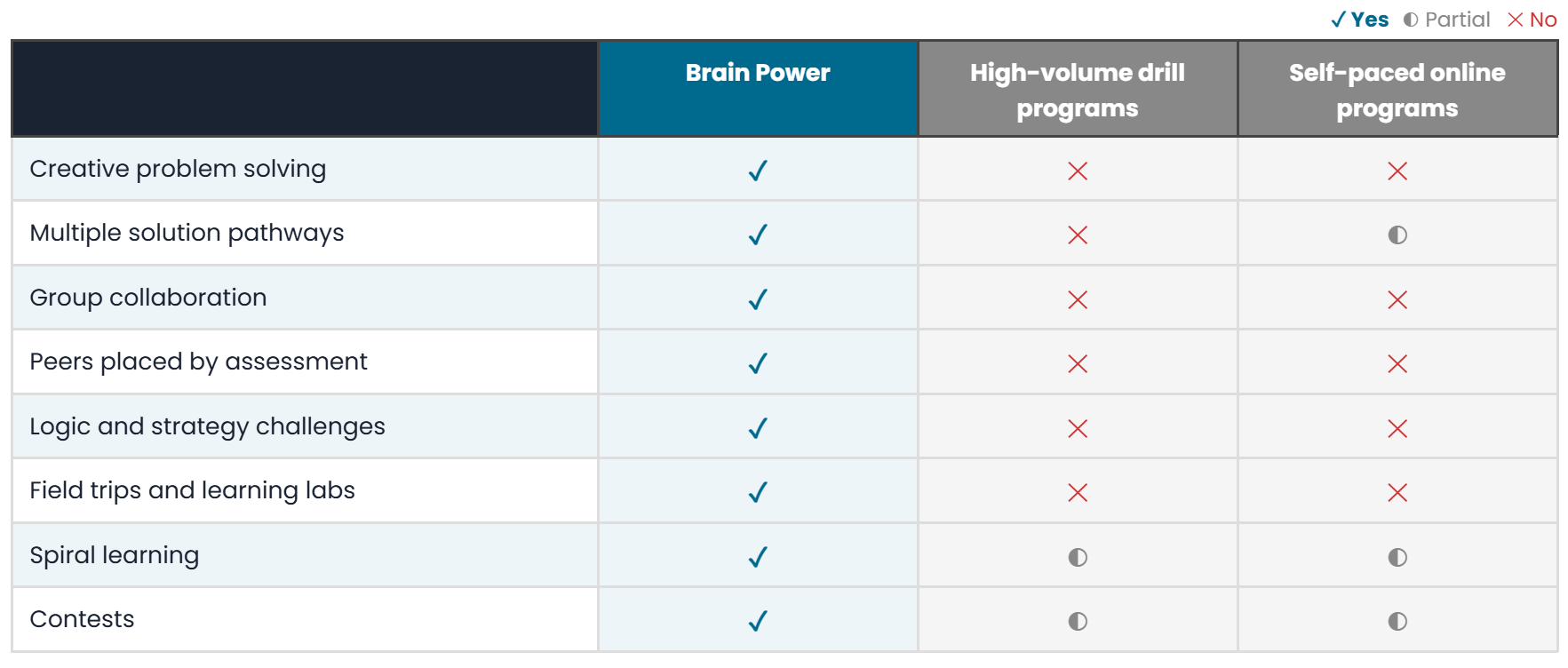
How Does Brain Power Compare?
Explore Locations
Find this program at these campuses
This program is currently offered and find a location that works for you.
British International School of Houston
Houston
Online Learning

Thornhill Woods
Vaughan
Oak Ridges/Jefferson
Richmond Hill
Olde Oakville
Oakville
Bathurst Manor
North Toronto
Port Credit
Mississauga
Summerhill
Midtown Toronto
Downtown Markham
Markham
Kingsway, High Park
Etobicoke
Annex
Downtown Toronto