
What Happens in Every Class
Concept Instruction
Each class introduces a new concept through examples and structured discussion. Students develop equation-solving techniques, geometric reasoning, and algebraic thinking before working independently.
Applied Problem Solving
Students translate real-world scenarios into equations, work through proofs, and apply triangle theorems to multi-step geometry problems. The emphasis is always on setting up the reasoning correctly before computing.
Logic and Strategy Challenges
Every class includes a standalone logic puzzle. Deduction grids, constraint problems, and pattern challenges build the systematic thinking that carries students into higher-level mathematics.
Homework Review and Discussion
Homework solutions are unpacked as a class. Students compare their equation setups and geometric arguments, not just their final answers. Errors are treated as data about where reasoning needs to sharpen.
Curriculum Spotlight
Finding Consecutive Integers Using Algebra
In Lesson 22, students tackle word problems such as:
“There are four consecutive even numbers. Twice the sum of the last two consecutive even numbers is 50 less than three times the sum of the first two consecutive even numbers. What are these four consecutive even numbers?”
At first, it looks like a number puzzle. But to solve it efficiently, students are asked to think algebraically. They define a variable for the first even number, represent the next three as related expressions, translate the words into an equation, and solve step by step. In one problem, they are drawing on a whole progression of skills: working with variables, building expressions, interpreting phrases like twice the sum and 50 less than, and solving a multi-step equation.
Students are learning how to turn language into mathematics and mathematics into a solution. This is exactly the kind of thinking high school math depends on. Before students can succeed with linear equations, functions, and more advanced algebra, they need to be fluent in modeling relationships like this one clearly and accurately.
Algebra is a powerful tool to turn a paragraph of words into an equation that can actually be solved.

What Topics Do we Cover in this Level?
Algebra and Equations
- Negative numbers and rational arithmetic
- Solving one-variable and complex equations
- Distributive property and factoring
- Equations with order of operations
- Translating word problems into expressions
- Solving inequalities and absolute value
and more
Proportions and Percentages
- Percents and rational numbers
- Introduction to proportions
- Percents and proportions combined
- Money and age problems using equations
- Solving problems with multiple unknowns
- Roman numerals and historical number systems
and more
Geometry and Proof
- Introduction to 2D geometry
- Triangle theorems and angle relationships
- Properties of isosceles triangles
- Congruence: SSS, SAS, and ASA
- Triangle midline theorem
- Quadrilaterals and their properties
- Pythagorean theorem
and more
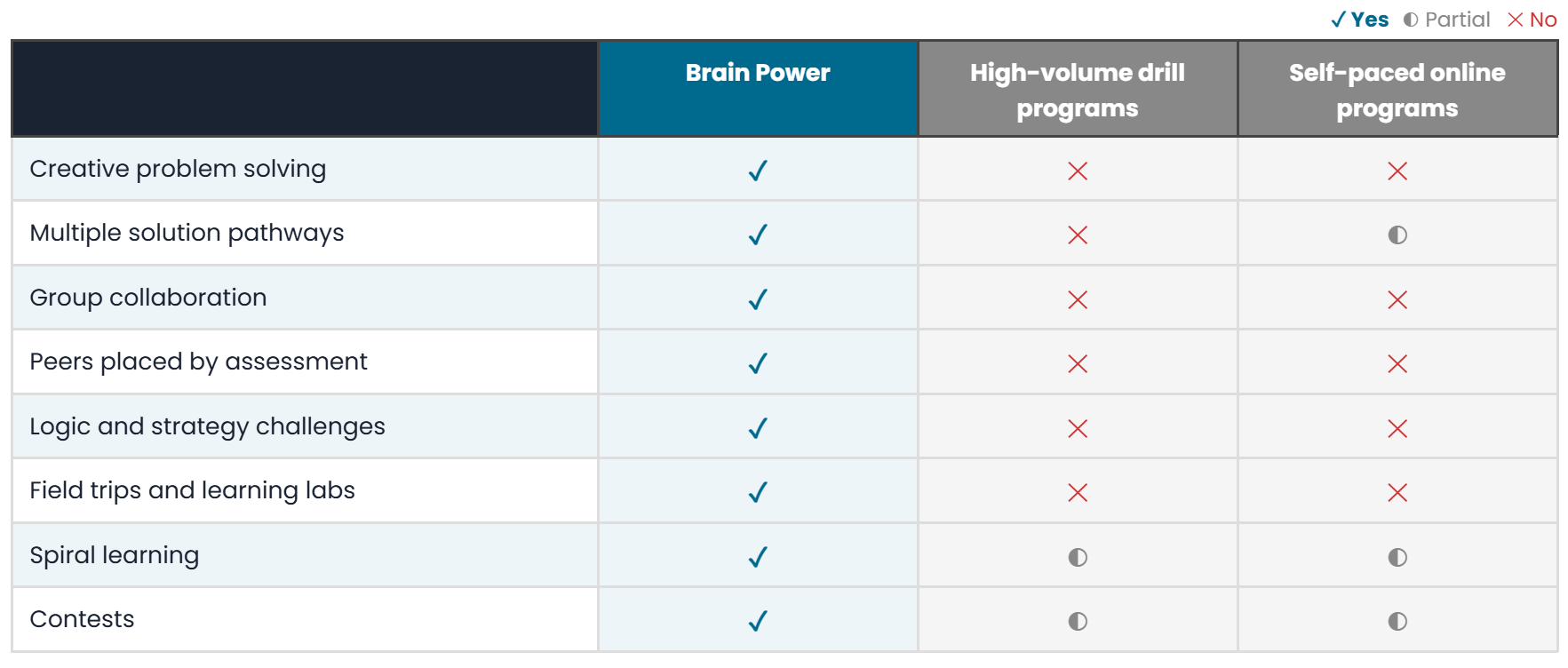
How Does Brain Power Compare?
Explore Locations
Find this program at these campuses
This program is currently offered and find a location that works for you.
Port Credit
Mississauga
Online Learning

Thornhill Woods
Vaughan
Olde Oakville
Oakville
Bathurst Manor
North Toronto
Oak Ridges/Jefferson
Richmond Hill
Summerhill
Midtown Toronto
Downtown Markham
Markham
Kingsway, High Park
Etobicoke
Annex
Downtown Toronto
Central Burlington
Burlington