Math & Problem Solving
Math Level D
Linear systems, exponents, probability, and the start of real abstraction.
What Happens in Every Class
Concept Instruction
New concepts in linear equations, systems, exponents, and probability are introduced through examples and structured class discussion. Students build technique and intuition before tackling independent work.
Applied Problem Solving
Students apply algebra to real scenarios: solving systems that model mixture problems and rate problems, computing surface areas of composite solids, and interpreting probability in everyday contexts.
Logic and Strategy Challenges
Every class includes a standalone challenge. Number theory puzzles, pattern problems, and constraint-based reasoning sit outside the day’s main topic and stretch the kind of thinking that no formula can shortcut.
Homework Review and Discussion
Homework is reviewed with an emphasis on method, not just answers. Students explain how they set up a system of equations or chose a solving strategy. The reasoning matters as much as the result.
Curriculum Spotlight
Understanding Linear Relationships
In Lesson 19, students explore problems like:
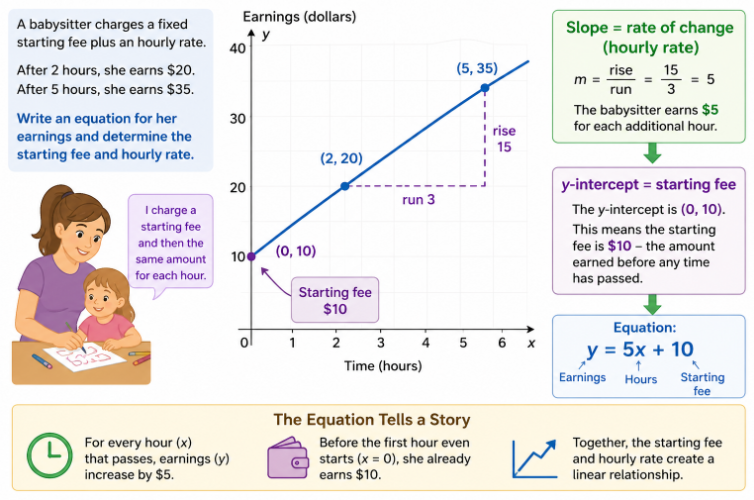
“A babysitter charges a fixed starting fee plus an hourly rate. After 2 hours, she earns $20. After 5 hours, she earns $35. Write an equation for her earnings and determine the starting fee and hourly rate.”
At first, it looks like a simple calculation. But students quickly realize this is not about computing, it’s about understanding a relationship. They begin by representing the situation on a graph, where time becomes the input (x) and earnings become the output (y). From there, they determine the rate of change and interpret it as the babysitter’s hourly pay. The y-intercept emerges naturally as the starting fee: the amount earned before any time has passed.
The equation is not just a formula. It tells a story. Students are learning that slope is not just a formula: “rise over run,” but a rate, and that intercepts are not just points, but meaningful starting values.
Every high school concept involving linear functions, graphing, and real-world modeling depends on this exact understanding.
Functions begin to make sense here, when students see that every line represents a real relationship between two changing quantities.
What Topics Do we Cover in this Level?
Algebra and Linear Equations
- Linear equations and systems of equations
- Solving systems by substitution and elimination
- Square roots and exponent rules
- Factoring and simplifying expressions
- Inequalities with two variables
- Word problems modelled with systems
and more
Geometry and Measurement
- Surface area of prisms, cylinders, and pyramids
- Volume of 3D composite solids
- The Pythagorean theorem applied in 3D
- Properties of circles and arcs
- Coordinate geometry and distance formula
- Geometric proofs with algebra
and more
Probability and Number Theory
- Introduction to probability
- Theoretical vs. experimental probability
- Counting principles and sample spaces
- Kaprekar’s Constant and number patterns
- The Collatz Conjecture and unsolved problems
- Statistical reasoning and data interpretation
and more
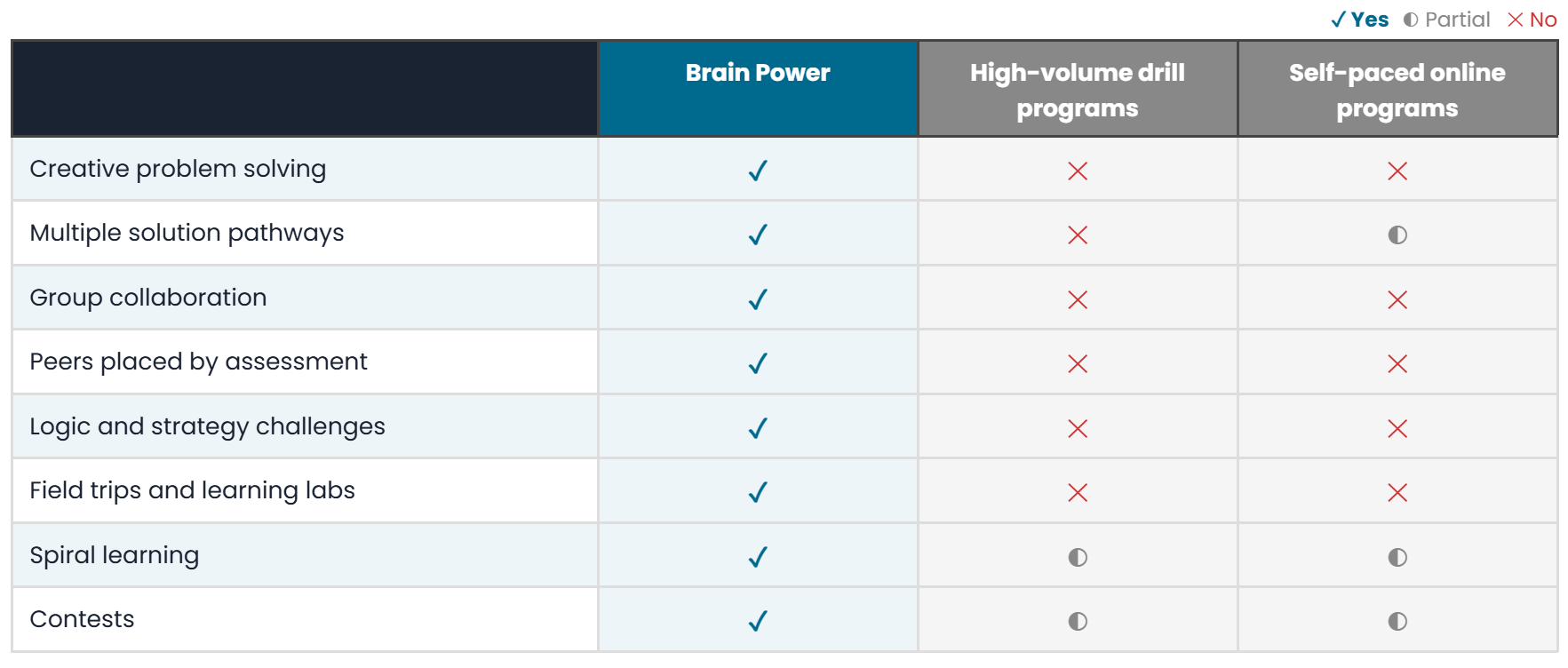
How Does Brain Power Compare?
Explore Locations
Find this program at these campuses
This program is currently offered and find a location that works for you.
Central Burlington
Burlington
Online Learning

Thornhill Woods
Vaughan
Oak Ridges/Jefferson
Richmond Hill
Olde Oakville
Oakville
Bathurst Manor
North Toronto
Summerhill
Midtown Toronto
Downtown Markham
Markham
Kingsway, High Park
Etobicoke