Public Speaking
Junior Public Speaking: Confident Communication
Finding a voice, one speech at a time.
Students in this program do more than memorize a script. They practice reading a room, defending an idea, and building on what a classmate says instead of shutting it down.
Junior Public Speaking gives them 34 weeks to practice exactly that.
What Happens in Every Class
Theory
Every class starts with theory, not shortcuts. Before students give a single speech, they learn Aristotle’s three appeals, ethos, pathos, and logos, the actual framework behind why an argument works. Understanding why something works is what lets a student build their own speech, not just copy someone else’s.
Application
Theory gets tested right away. After learning ethos, pathos, and logos, students write and deliver an instructional speech, then a storytelling speech built around a moral, choosing on purpose which appeal to lean on for each one.
Group Engagement
Students build and deliver video presentations, record voiceovers, and take part in a full debate unit that ends in a Debate Day, building a case and defending it in front of their peers.
Applied Thinking
As part of the debate unit, students argue a side of a topic, sometimes the side they do not personally agree with. Building the strongest case for a position other than your own takes real research, and it is what resolves a real disagreement instead of repeating your side louder.
Curriculum Spotlight
Week 8: Ethos, Pathos, and Logos
Week 7 covers rhetoric and rhetorical devices.
Week 8 narrows that down to Aristotle’s three appeals: ethos (credibility), pathos (emotion), and logos (logic). Students learn to name which one a speaker is using.
The same three ideas return in Week 11 and again in the final persuasive speech unit, so students get more than one chance to use them.
What Topics Do we Cover in this Level?
Evidence-Based Communication & Critical Thinking
- Rhetoric and rhetorical devices
- Ethos, pathos, and logos
- Literary devices, including metaphor, simile, and alliteration
- Researching topics and building evidence-based arguments
- Supporting claims with credible evidence and examples
- Structuring speeches around a clear message or moral
- Asking and responding to thoughtful follow-up questions
- Reflecting on speeches and improving communication through feedback
and more
Finding Your Voice
- Managing pace and filler words
- Volume and pronunciation
- Intonation and tone
- Body language and speaking etiquette
- Hand gestures
- Speaking in front of a group
and more
Adaptive Tool Use
- Camera etiquette for vlogging
- Sustaining audience attention
- Writing for a specific target audience
- Voiceover scriptwriting and character work
- Building an introduction and conclusion
- Writing a hook for a persuasive speech
and more
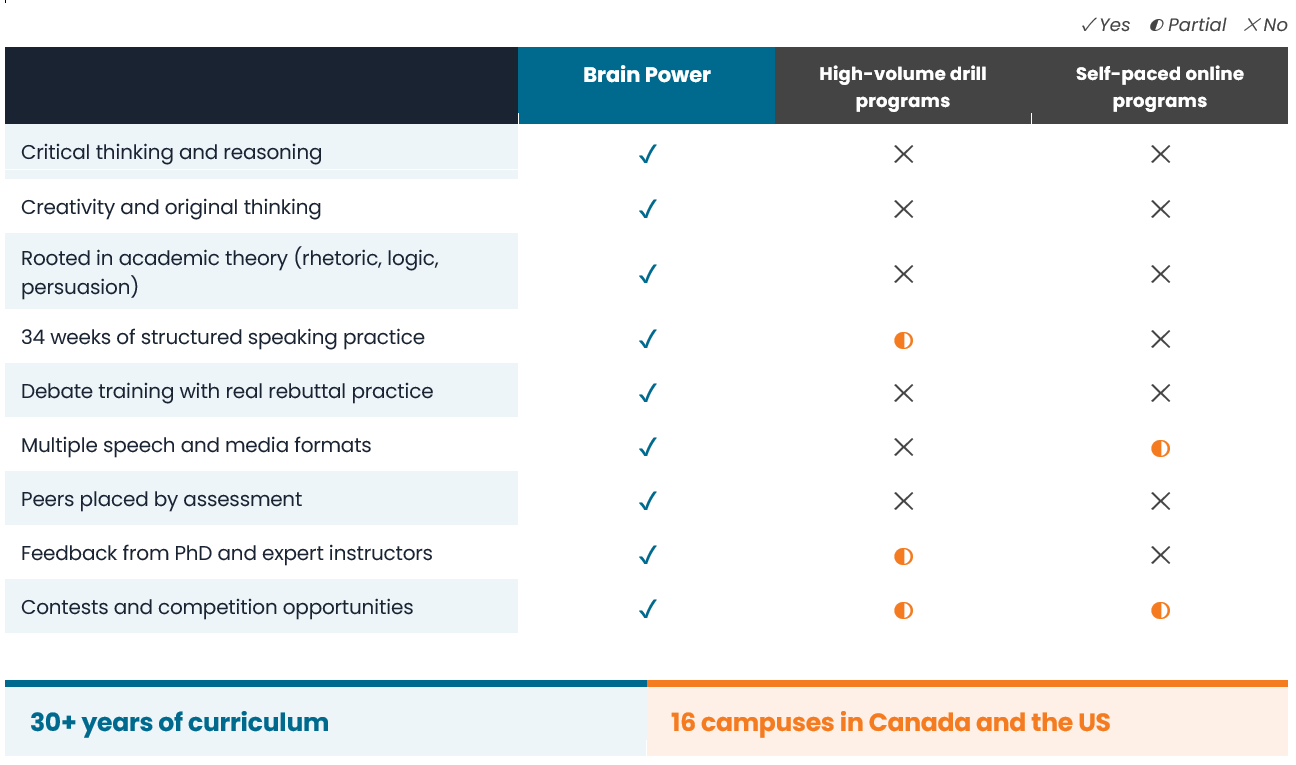
How Does Brain Power Compare?
Explore Locations
Find this program at these campuses
This program is currently offered and find a location that works for you.
Annex
Downtown Toronto
British International School of Chicago Lincoln Park
Chicago
Online Learning

Thornhill Woods
Vaughan
Oak Ridges/Jefferson
Richmond Hill
Olde Oakville
Oakville
Summerhill
Midtown Toronto
Downtown Markham
Markham