
Public Speaking
Intermediate Public Speaking: The Power of Persuasion
Building arguments that hold up under pressure
Students who can already speak in front of a class are ready for something harder: building an argument that holds up when someone pushes back.
What Happens in Every Class
Theory
Each unit starts with the theory behind the technique: rhetoric, logos, and pathos are taught as concepts first, the reasoning and emotional appeal behind any argument, before students use them. Knowing why a technique works is what lets a student adapt it, not just repeat a memorized structure.
Application
Students apply logos and pathos directly: a demonstrative speech that has to be logically clear, and a persuasive speech that has to land emotionally. A dedicated data storytelling unit then teaches them to build a case around real numbers, not just claims.
Group Engagement
A full debate unit takes students through building a case, presenting it, and defending it against a rebuttal, alongside a multi part video presentation project that runs from the first hook to audience engagement.
Applied Thinking
A unit on sales runs directly into a unit on ethics. Students learn the persuasion techniques used in advertising, then discuss where influence turns into manipulation, a distinction that matters just as much when a friend is trying to talk them into something as when they are the one doing the persuading.
Curriculum Spotlight
The Three-Part Debate Unit
Debate runs across three separate weeks. In Part 1, students research a topic and build a case for one side. In Part 2, they present that case to the class. In Part 3, they respond to the opposing side and defend their own position.
Splitting debate into three weeks gives students real time to prepare instead of arguing on the spot. By Part 3, they have already heard the other side’s argument.
What Topics Do we Cover in this Level?
Evidence-Based Communication & Critical Thinking
- Introduction to rhetoric and persuasive communication
- Using logos, pathos, and figurative language to communicate effectively
- Data storytelling, media literacy, and evaluating journalism
- Researching and building a strong debate case
- Responding effectively to opposing arguments and viewpoints
- Analyzing speeches to identify strengths and areas for improvement
- Distinguishing persuasion from manipulation and recognizing advertising techniques
- Understanding what makes ideas memorable, compelling, and impactful
and more
Finding Your Voice
- Voice, timing, and confidence
- Deliberate self-introductions
- Speaking with impact
- Delivering humour with correct timing
- Performing slam poetry
- Camera presence for vlogging
and more
Adaptive Tool Use
- Identifying the right type of speech for the occasion
- Writing a captivating hook
- Understanding a target audience
- Framing a message using future tense
- Occasion speeches
- Building a vlog from tagline to delivery
and more
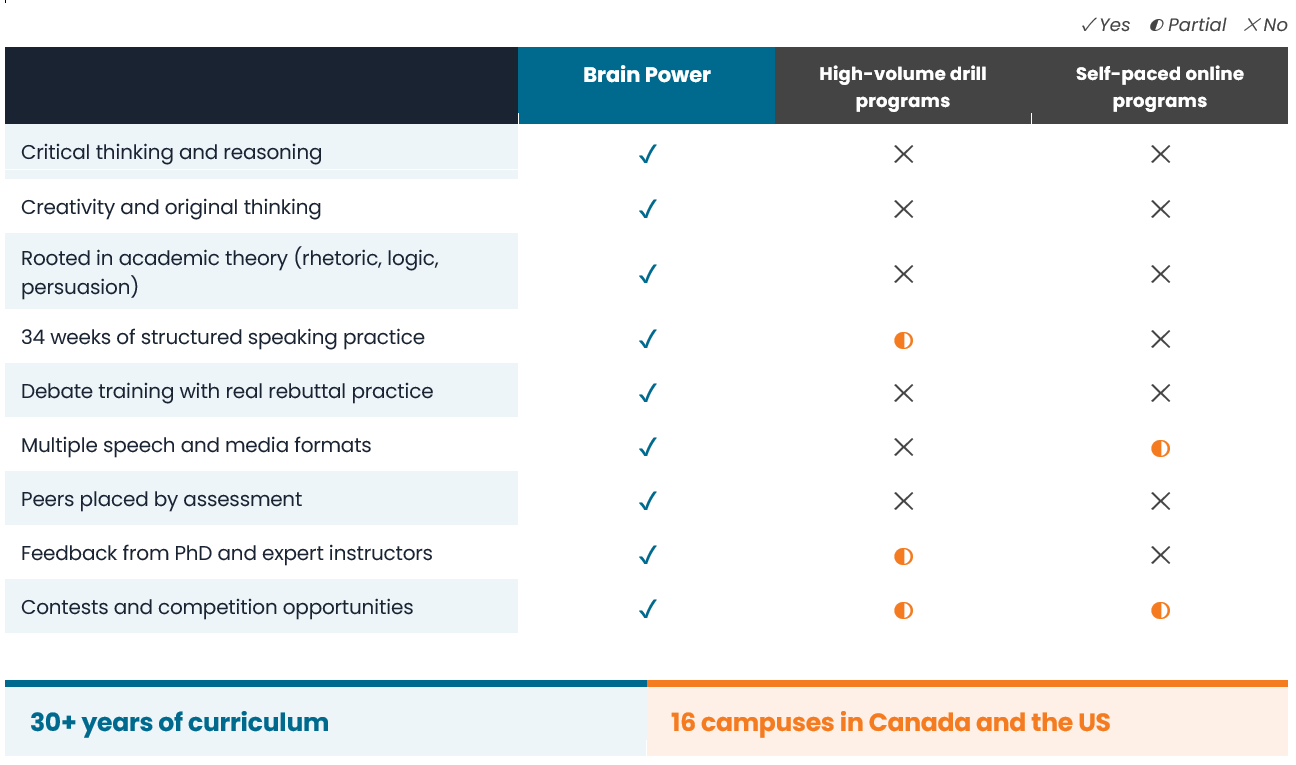
How Does Brain Power Compare?
Explore Locations
Find this program at these campuses
This program is currently offered and find a location that works for you.
British International School of Houston
Houston
Online Learning

Thornhill Woods
Vaughan
Oak Ridges/Jefferson
Richmond Hill
Olde Oakville
Oakville
Bathurst Manor
North Toronto
Port Credit
Mississauga
Summerhill
Midtown Toronto
Downtown Markham
Markham
Kingsway, High Park
Etobicoke
Annex
Downtown Toronto
Central Burlington
Burlington