Public Speaking
Senior Public Speaking: The Language of Leadership
Rhetoric, negotiation, and the art of being heard
A strong idea still needs the right delivery, whether that is a debate, a job interview, or a podcast.
What Happens in Every Class
Theory
Classes are built on real theory, not simplified checklists. Formal logic, rhetoric, and behavioural economics, the study of why people actually make decisions, are taught from their original sources, so students understand the reasoning well enough to build their own argument.
Application
Behavioural economics gets applied right away: a persuasive speech day, a competitive Speaker’s Idol event, and an advanced data storytelling unit where students learn to make numbers argue a point, not just illustrate one.
Group Engagement
A multi week debate unit and a podcasting unit build toward a final speech presentation delivered to a live audience at year’s end.
Applied Thinking
Negotiation and interview skills are taught back to back. Reading another person and adjusting an approach mid conversation matters in a college interview, a summer job negotiation, or any conversation where the other side has something you want.
Curriculum Spotlight
Weeks 24 and 25: Behavioural Economics
Behavioural economics looks at why people actually make decisions, often different from the reason they give. Robert Cialdini organized this into six principles: reciprocity, commitment, social proof, authority, liking, and scarcity.
Students spend two weeks finding these principles in real advertising, then apply them in Week 26 (Sales) and Week 27 (Negotiation), thinking about whether the use is fair.
What Topics Do we Cover in this Level?
Evidence-Based Communication & Critical Thinking
- Rhetoric, formal logic, and effective reasoning
- Building ethos, credibility, and trust in communication
- Behavioural economics and how people make decisions
- Advanced data storytelling and communicating complex information
- Figurative language, humour, and techniques for making ideas memorable
- Empathy: learning to comprehend, convey, and connect
- Analyzing and dissecting speeches, with self-review after recorded presentations
- Distinguishing persuasion from manipulation and constructing advanced satire
and more
Finding Your Voice
- Voice, timing, and confidence
- Handling fear and pivoting mid speech
- Working with a vocal coach
- Recording a polished take
- Interpersonal communication
- Delivering satire without losing the audience
and more
Adaptive Tool Use
- Hooks and conclusions
- The power of storytelling
- Building a podcast episode
- Mastering interview skills
- Negotiation
- Speaker’s Idol style competition speeches
and more
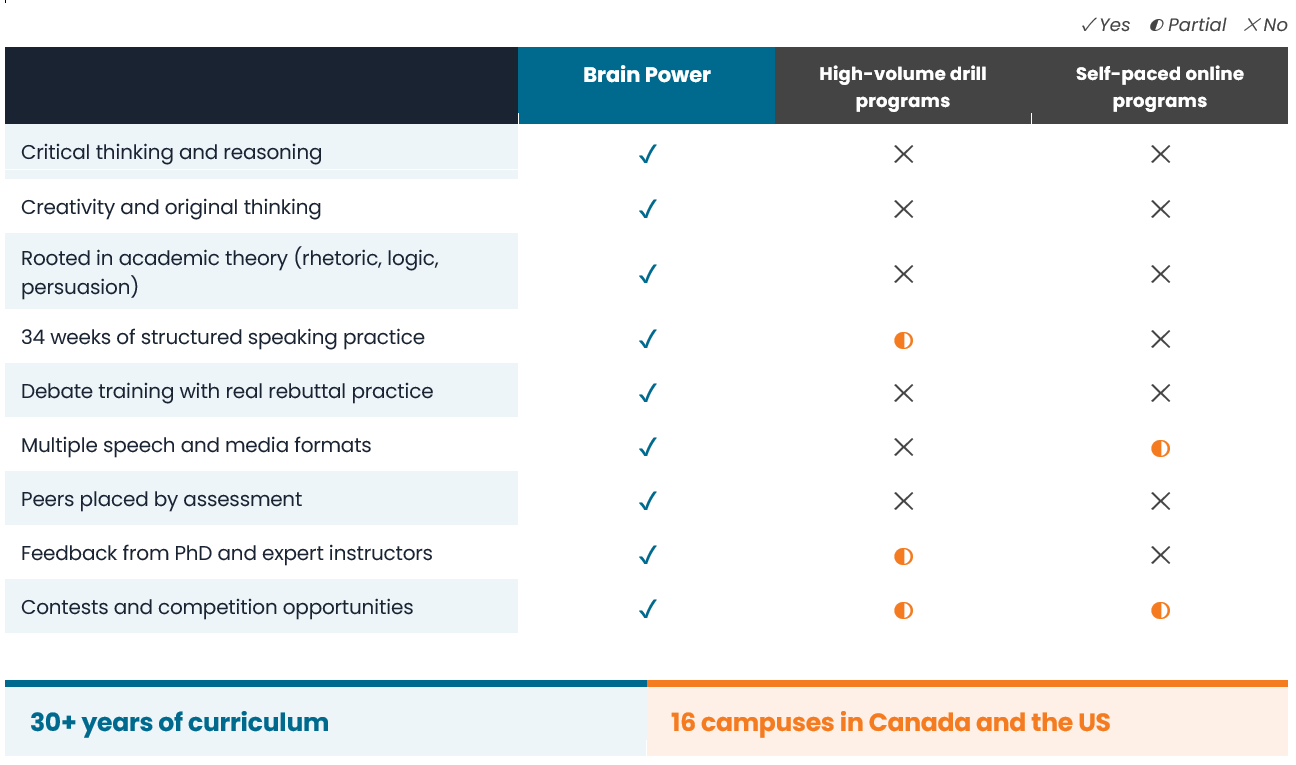
How Does Brain Power Compare?
Explore Locations
Find this program at these campuses
This program is currently offered and find a location that works for you.
Online Learning

Thornhill Woods
Vaughan
Olde Oakville
Oakville
Bathurst Manor
North Toronto
Summerhill
Midtown Toronto
Downtown Markham
Markham